
In this country we have an unhealthy, dysfunctional and quite frankly, annoying habit of ‘mauvelanging’ (yes, I just made it a verb) or bad-mouthing people.
We often do it under the guise of speaking the truth, all the while whispering ‘juicy’ snippets about other people, snippets we did not fact-check or verify, which, if we’re honest we couldn’t be bothered to do anyway.
We often share such information freely and justify our behaviour by saying our broadcasting of this information is ‘for their own good’, to warn them of smart-men and con artists, loose women and men as well as crooked politicians.
Even the most pious amongst us has committed the acts that I mentioned above and I’m sure we’ve never concerned ourselves with the consequences of our words, texts, ‘cut-eyes’, facebook/twitter/Insta posts or memes sent via WhatsApp. Indeed, we could be on the receiving end of an unexpected pre-action protocol letter or even more seriously a defamation claim filed in the courts.
Be warned, there have been numerous cases within the last decade which involve social media defamation.
Social Media Defamation – Facebook, Twitter, WhatsApp
The legal implications of using social media have not been given much thought in our part of the world. Interestingly, in the wider world persons have brought libel claims regarding most social media platforms, for instance Facebook and Twitter.
In the UK in 2017 one, Jack Monroe was awarded £24,000 in damages, a comparatively large sum, by the High Court following two tweets sent by a MailOnline columnist Katie Hopkins in May 2015 (Monroe v Hopkins [2017] EWHC 433 (QB) ). Meanwhile in India, a WhatsApp message which harms the reputation of an individual can come under the purview of defamation. In 2016, one interesting defamation case involved the Claimant seeking an injunction before the Delhi High Court against ‘defamatory posts’ in a WhatsApp group, the group administrator and other members of the group were identified as the Defendants in the matter. The court granted a perpetual injunction in favour of the Claimant and strongly advised a certain Defendant that he could not defame or abuse the Claimant any further, but stopped short of holding the group Administrator liable for defamatory statements made by a member of the group. In Ireland, social media posts have even gotten one person sentenced to imprisonment for five years for online harassment. Also in Ireland, comments on Facebook caused one man to be ordered to pay the plaintiff €75,000.
Even in Australia, victims have taken legal action based other persons’ on comments, posts or likes on Social Media, specifically Facebook. In 2016, one woman was awarded Aus$180,000 in damages for defamatory statements made about her on Facebook. Her original claim was for compensatory and aggravated damages in defamation following nine defamatory posts on Facebook, she also sought to have the Defendant permanently restrained from publishing the nine defamatory posts and the imputations and false allegations that arose from those posts. Note that the Defendant posted these statements on his Facebook page and the judgement actually took into consideration how many Facebook friends the defendant had as well as the number of users the accessed Facebook worldwide, in addition to the number of likes and comments made by other Facebook users.
Locally, one recent case in particular has gotten my attention, Heidi Joseph v Ama Charles [2016]. The Claimant was awarded TT$75000 in damages as well as costs. The Defendant in this matter made statements about the Claimant on Facebook, notably the Trinidad and Tobago Prison Service’s (TTPS) Facebook page as well as her own Facebook page. I will not go into the details of the statements made.
What is instructive is the Court’s reasoning in determining this matter, the Court quoted Halsbury’s Laws of England Volume 32 (2012) at paragraph 566 which explains that: “An individual who posts defamatory material on the internet is a publisher of that material if it is subsequently accessed and read by a third party.” That being said, the Court found that the Defendant was responsible for publishing the words complained of and deliberately tagging the page administrators of other well-known local media programmes. Further, it was stated that the Defendant was “ultimately responsible for words which she initially published once they remained in the form she originally published.” By tagging persons on her Facebook page, who she didn’t have any control over, the Defendant, “implicitly gave them permission to forward her publication to third parties“, so she must “bear the responsibility of where her words ultimately ended up….”
What’s the key take away in this particular instance? I would suggest that we all take a step back and realise that, we are all ultimately responsible for what we publish on any social media platform and we must bear the responsibility of where these publications end up.
One could argue that these social media platforms should play a role in controlling their users behaviour, actually, they do. It should be noted that the WhatsApp Terms of Use, Acceptable use of our services, expressly prohibit anything that is, inter alia, defamatory, threatening, harassing. Facebook actually has a Defamation reporting form on its site. Other social media platforms have similar Terms of use, so read the fine print when you sign up and please be guided accordingly.
In this day and age one needs to be careful about what one says, writes, likes, shares, comments on and forwards on Social Media. I have no doubt that in the coming months and years our courts will be faced with a growing number of Social Media defamation claims given our society’s cultural propensity to speak ‘off-the-cuff’, often without basing such statements on any facts or evidence and our love of publicly giving “fatigue” and ‘bad talking’ each other.
Just look at this comic I found on Pinterest posted by Altizer Law. I believe the caption says it all.
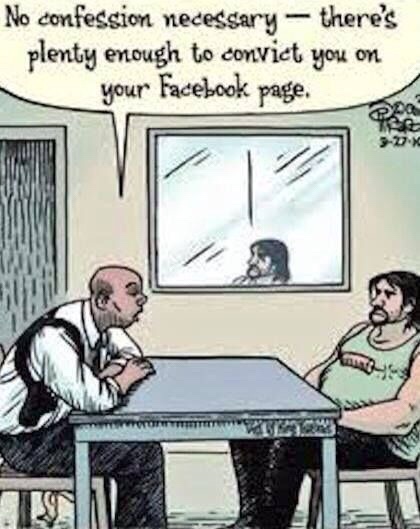
I myself have often thought long and hard about sharing, commenting on and liking the posts I see on Facebook and the memes I receive via WhatsApp and Twitter, after all most of them are extremely funny and admittedly appeal to my basest instincts, without the benefit of any investigation or facts. Lately, I have gotten better at opting to delete rather than share some of the more questionable posts for fear of an eventual lawsuit or defamation claim. I humbly suggest that you, my dear reader, do the same.
Think before you click.
Best,
Simone
References:
Click to access CvA_13_P154DD26mar2018.pdf
http://www.bailii.org/ew/cases/EWHC/QB/2017/433.html
Click to access monroe-v-hopkins-2017-ewhc-433-qb-20170329-rev-1.pdf
https://www.whatsapp.com/legal/#terms-of-service
Click to access cv_16_02996DD01jun2018.pdf

 Phoenix Legal and Consulting Services
Very valuable information that all bloggers should be aware of. Trinidad has become very litigating society and sometimes we have the tendency to take a joke too far.
But one question I have is with regards to memes made from videos. Can those be the considered as defamatory?
LikeLike
Thanks for your feedback.
To respond to your question, based on my review of the cases and the laws that are currently on the books, I believe memes made from videos can be defamatory based on the content found therein and whether that content passes the ‘tests’ I mentioned in my first blog on defamation.
Your question was an excellent one. It’s piqued my interest, I’m going to do some research on that topic and let you know what I find!
Thanks for reading.
LikeLike