
Mediation Missteps: 7 Errors That Can Cost You Time, Money, and Peace of Mind

I love mediation.

I love negotiating positions and arriving at workable solutions. I think that Mediation is the most powerful tool for resolving most disputes without the stress, cost, and time of a courtroom battle. I’m the first to admit that mediation is not a panacea, however, whether it’s a business disagreement, a workplace conflict, or a family matter, mediation gives everyone a chance to be heard, find common ground, and reach a mutually beneficial solution (most of the time).

But like any process, success in mediation depends on preparation and approach. Unfortunately, many participants make simple mistakes that can derail the process or prevent the best possible outcome. Here are some common pitfalls to avoid so you can make the most of your mediation experience:


1. Coming in with a “Win or Lose” Mindset

Mediation isn’t about beating the other side—it’s about finding a solution everyone can live with, long term. When parties enter with a combative, antagonistic ‘courtroom’ mentality, they miss opportunities for compromise and creative problem-solving.
I always tell clients to shift their focus from “winning” to resolving. I tell them to ask themselves, “What outcome can I accept so we can move forward?” I’ve realised that in many cases they haven’t thought about the issue using this frame, but when they do they are able to move past most blockages which allow for more meaningful, honest communication and resolution.


2. Not Being Fully Prepared

Showing up without the right documents, facts, or a clear idea of what you want can waste valuable time. I often tell my clients ahead of time what they need to do to prepare for a mediation session, for instance I advise them of who the mediator is, what they do, I remind them of what documents they need to bring along as well as what sort of records they need to peruse, or mine for information and relevant materials. I also indicate ahead of time how the mediation session is expected to proceed as well as the contents of the Agreement to Mediate.
In order to ensure that you are fully prepared for a mediation session be sure to gather all relevant information ahead of time. Write down what I call your PCNs, your priorities, possible concessions, and any non-negotiables, this practice assists all parties to clarify their thoughts and positions and ultimately leads to a smoother discussion.


3. Failing to Listen

It’s easy to focus only on your side of the story, but successful mediation requires listening—really listening—to the other party. Mediation is a voluntary process and as such each party engaging in a mediation session should come to the table with an open mind and open ears.
I always tell my clients to try to understand the other person’s perspective, empathy goes a long way to resolve disputes. I remind them that they don’t have to agree with each position or even each version of events or facts they hear described but they should listen to the other party in order to move the process forward. Always bearing in mind that one of the purposes of mediation is to allow persons to be and feel heard.


4. Letting Emotions Take Over

Conflict can bring up anger, hurt, or frustration. While these feelings are valid, letting emotions control the conversation can stall progress. in some instances mediators have to call a halt to or pause discussions to allow the ‘temperature’ in the room to cool. Sometimes a caucus is held to allow one party to share their feelings freely without interruption so as not to inflame the discussions further. Mediators have many options to assist in diffusing tensions when things get too heated. In some cases where emotions are triggered by some traumatic incident persons may be referred to counselling or therapy with a licensed clinician before discussions could resume. Indeed in some extreme cases therapy should take place before mediation is attempted.
However, in less volatile cases I always tell clients to take breaks if needed, breathe deeply, and keep their tone respectful. It is important to remind persons that the goal is resolution, not revenge.


5. Ignoring the Mediator’s Role

The mediator is there to guide the process, keep things on track, and help explore options. Treating them like a judge—or worse, disregarding them—undermines the process. I am always weary of mediation parties who demonstrate very early on their intention to disregard the mediator and their guidance. It is important that parties to a mediation understand in advance of the session who the mediator is and is not and what the mediator does and does not do.
I tell clients that it is important to select a mediator that both parties trust and respect, a mediator with the appropriate expertise is also a good choice. Mediators are neutral and focused on helping both sides find common ground, the parties just have to trust the mediator and the process.


6. Rejecting Creative Solutions

Sometimes, the best solution isn’t obvious. Parties who stick rigidly to one outcome often miss out on win-win alternatives. Many parties enter mediation with a preconceived notion of what ‘victory’ looks like, they are often closed to other options and in many instances refuse to think outside of the box. It is important to stay open-minded and flexible, this is where the PCNs list comes in, sometimes seeing your own positionality, your negotiating perimeter if you will, in writing, is helpful and allows for creative problem solving. Sometimes creativity requires the use of tools and techniques such as mind mapping, the use of white boards or even tech tools. Throw into the mix a bit of humility and the right amount of compromise, and you just might reach a solution that satisfies everyone’s key needs. I always encourage my clients to be open to all options and to focus on the outcome.


7. Not Considering the Future

Some parties only focus on resolving the immediate conflict, forgetting to address long-term concerns. This is where honesty and full transparency is required. Sometimes parties are not coming to the mediation with ‘clean hands’ (to borrow the maxim from Equity) or clean hearts. Mediation requires parties to be honest and to lay all their cards on the proverbial table, that’s sometimes the only way to propel the matter forward positively. I know that persons are often scared to be fully transparent and that’s where your agreement to mediate comes in (I will do another post on this in the coming weeks, so stay tuned). A properly drafted agreement to mediate ensures that persons understand the ground rules and the boundaries, and can feel safe about operating in the mediation environment which is protected by the guardrails established in the agreement.

It is also important for parties to think about what will help maintain a positive outcome and prevent similar disputes in the future, this requires foresight and forward planning. Brainstorming works in this instance, where parties are encouraged to think about the root cause of the conflict or what gave rise to the need to mediate in the first instance and to identify conflict resolution options in advance of any other action. Sometimes I ask clients to prepare a wish list of items/actions that they would like to address within the confines of the current mediation, alternatively, I ask them to think about the short, medium or long term implications of the mediation agreement that is produced at the end of the mediation session to ensure that they take as much of the potential implications of their agreement into consideration.


My Final Thoughts

Mediation works best when participants voluntarily come prepared, stay open-minded, and focus on finding a workable solution instead of “winning.” By avoiding these common mistakes, clients give themselves the best chance of walking away with an agreement that works for everyone.

Embracing Diversity: The Cornerstone of Effective Corporate Governance in the Caribbean

Picture this: a boardroom where voices from all walks of life converge, where diverse perspectives collide to spark innovation, and where inclusion is not just a buzzword but a guiding principle. Welcome to the future of corporate governance in the Caribbean, where diversity isn’t just a nice-to-have; it’s an absolute necessity for driving sustainable growth and success in today’s globalized marketplace.

A couple of weeks ago I wrote a blog about the importance of women in leadership, this blog is a follow on from that earlier post because it got me thinking diversity in a broader sense. In recent years, there has been a growing recognition of the critical role that diversity plays in corporate governance, and the Caribbean region is no exception. As the world becomes increasingly interconnected, companies operating in the Caribbean must adapt to a rapidly changing business landscape characterized by evolving consumer demographics, shifting market dynamics, and heightened expectations for transparency and accountability.

So, what exactly do we mean by diversity on a board of directors? Diversity goes beyond mere representation; it encompasses a wide range of dimensions, including gender, ethnicity, religion, sex, age, professional background, and expertise. A diverse board brings together individuals with unique perspectives, experiences, and insights, enriching the decision-making process and enhancing the board’s ability to anticipate risks, identify opportunities, and drive strategic innovation.

But diversity isn’t just a matter of social responsibility or political correctness; it’s also a smart business strategy. Numerous studies have shown that diverse boards outperform their homogenous counterparts in terms of financial performance, innovation, and long-term value creation. By embracing diversity, companies can tap into a broader talent pool, better understand and serve diverse customer segments, and foster a culture of creativity, collaboration, and inclusion that drives sustainable competitive advantage.

In the Caribbean context, where diversity is not only a fact of life but also a source of strength, the case for diverse boards is particularly compelling. With its rich tapestry of cultures, languages, and traditions, the Caribbean is uniquely positioned to leverage diversity as a strategic asset in the boardroom. By harnessing the collective wisdom and insights of diverse board members, Caribbean companies can navigate the complexities of the regional business landscape more effectively, identify new growth opportunities, and build stronger relationships with stakeholders across the region and beyond.

Moreover, diverse boards are better equipped to address the unique challenges facing Caribbean companies, from climate change and natural disasters to socioeconomic inequality and political instability. By bringing together individuals with diverse perspectives and expertise, boards can develop more robust risk management strategies, enhance corporate resilience, and contribute to the region’s long-term sustainability and prosperity.

But achieving diversity on Caribbean boards requires more than just good intentions; it requires a concerted effort to challenge the status quo, dismantle barriers to inclusion, and foster a culture of diversity and belonging. Companies must proactively recruit, retain, and promote diverse talent, implement policies and practices that promote equity and inclusion, and hold themselves accountable for progress towards diversity goals.

In conclusion, diversity isn’t just a moral imperative; it’s a strategic imperative for corporate governance in the Caribbean. By embracing diversity on their boards, companies can unlock new sources of innovation, drive sustainable growth, and build stronger, more resilient organizations that are better equipped to navigate the challenges and opportunities of the 21st century. The time to embrace diversity is now.

The Imperative of Women in Leadership

In today’s rapidly evolving business landscape, the call for diversity and inclusivity isn’t just a moral imperative; it’s a strategic necessity. Among the crucial facets of diversity, the representation of women in leadership positions stands out as an area that demands urgent attention. While progress has been made over the years, the journey towards achieving gender parity in leadership roles remains incomplete. It’s time for organizations to recognize the immense value that women bring to the table and actively work towards fostering an environment where they can thrive.

Diversity in leadership isn’t merely about ticking boxes or meeting quotas; it’s about harnessing the full spectrum of talent and perspectives to drive innovation and sustainable growth. Research consistently underscores the benefits of gender-diverse leadership teams, from enhanced decision-making to improved financial performance. By leveraging a diverse range of viewpoints, organizations are better equipped to anticipate market trends, navigate complex challenges, and capitalize on emerging opportunities.

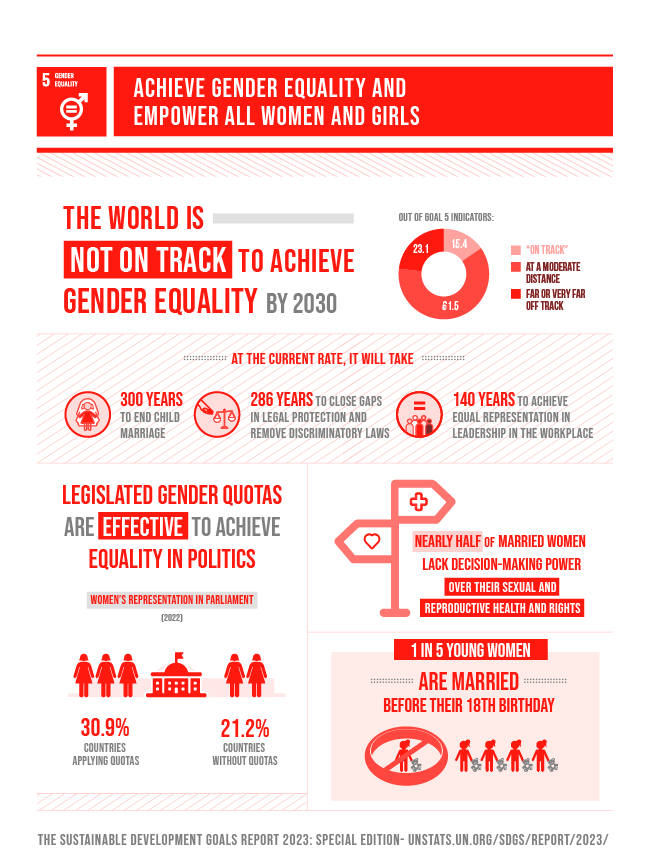
Yet, despite the compelling business case for gender diversity, women continue to be underrepresented in leadership roles across various industries. Take look at the UN SDGs, in particular, the progress we have not made as a civilisation towards the achievement SDG 5, Gender Equality. According to the UN, we are 140 years away from achieving equal representation in leadership in the workplace, note that “globally women held only 28.2% of management positions in 2021 (up just 1% since 2015), although they accounted for almost 40% of total employment.” (UN Dept of Economic and Social Affairs, 2023).

Source: https://sdgs.un.org/goals/goal5

Structural barriers, unconscious biases, and entrenched stereotypes often hinder their progress, creating a persistent gender gap in the upper echelons of organizations. Addressing these barriers requires a multifaceted approach that encompasses policy changes, cultural shifts, and targeted initiatives aimed at empowering women throughout their career journeys.

One of the primary drivers of change lies in fostering inclusive workplace cultures where women feel valued, respected, and supported in their professional aspirations. This entails creating opportunities for mentorship, sponsorship, and leadership development programs tailored to the unique needs and challenges faced by women. By providing avenues for skill enhancement, networking, and career advancement, organizations can cultivate a pipeline of talented female leaders poised to take on senior roles.

Moreover, it’s crucial to challenge traditional notions of leadership that may inadvertently favor certain attributes or behaviors over others. Leadership isn’t a one-size-fits-all concept; it encompasses a diverse array of styles and approaches. Embracing this diversity not only enriches organizational culture but also fosters a more inclusive and equitable environment where individuals are valued for their unique contributions rather than conforming to narrow stereotypes.

Beyond internal initiatives, organizations can also play a pivotal role in driving systemic change by advocating for policies and practices that promote gender equality at the societal level. This includes initiatives such as pay equity, parental leave policies, and flexible work arrangements that enable women to balance their professional and personal responsibilities effectively. By championing gender-inclusive policies both within and beyond their own walls, organizations can contribute to creating a more equitable society where women have equal opportunities to thrive.

In conclusion, the imperative of having more women in leadership positions isn’t just a matter of fairness; it’s a strategic imperative that can drive organizational success in an increasingly complex and interconnected world. By fostering inclusive cultures, challenging stereotypes, and advocating for gender equality both internally and externally, organizations can unlock the full potential of their talent pool and pave the way for a more prosperous and sustainable future. It’s time to break down the barriers that hold women back and unleash their power as leaders, innovators, and change agents. The time for action is now.