Who is a citizen in Trinidad and Tobago?

The strength of the Nation depends on the strength of its citizens.

Dr. Eric Williams, INDEPENDENCE DAY ADDRESS 1962

Who is a Citizen?

Very simply, a citizen is a member of a particular state or country, this person has particular rights or privileges based on various identified criteria. 

TT national flag

Citizenship in the Republic of Trinidad and Tobago

In the Republic of Trinidad and Tobago there are certain categories of Citizenship which are as follows:

CATEGORIES
Citizenship by Registration (Citizens of Commonwealth and Republic of Ireland)
Citizenship by Registration of a Minor 
Citizenship by Naturalisation (Non Commonwealth Citizens)
Citizenship for a child born to a citizen of Trinidad and Tobago by descent
Re-acquisition – Citizenship made by a former citizen of Trinidad and Tobago (other than birth or descent)
Restoration of Trinidad and Tobago Citizenship


Persons may become Citizens of Trinidad and Tobago via the following means
BIRTH
  A person born in Trinidad and Tobago subject to Section 17 (2) of the Constitution Chapter 1:01.
DESCENT (1)
  A person born outside Trinidad and Tobago of a citizen of Trinidad and Tobago other than by descent subject to Section 17 (3) of the Constitution Chapter 1:01.
DESCENT (2)
  A child who was born outside of Trinidad and Tobago of a citizen of Trinidad and Tobago by descent and who was granted, on application a Certificate of citizenship of Trinidad and Tobago in accordance with Section 5(1) of the Citizenship Act Chap 1:50.
REGISTRATION
  A person who is registered as a citizen of Trinidad and Tobago in accordance with Sections 7(1), 8(1) and 8 (2) of Citizenship Act Chapter 1:50
NATURALIZATION
  A person who is a naturalised citizen of Trinidad and Tobago in accordance with Section 12(1) of Citizenship Act Chapter 1:50
REACQUISITION
  A person, who reacquired Trinidad and Tobago citizenship by the grant of a Certificate of Citizenship in accordance with Section 11(2) of the Citizenship Act Chapter 1:50.
RESTORATION
  A person whose Trinidad and Tobago citizenship was restored by the grant of a Certificate of Restoration of Citizenship in accordance with Section 11 (2B) of the Citizenship Act Chapter1: 50.
ADOPTION
  A minor who was adopted in Trinidad and Tobago by a citizen of Trinidad and Tobago in accordance with Section 6 of Citizenship Act 1:50.
In order to apply for a Trinidad and Tobago passport one must be a citizen of Trinidad and Tobago.
 
Sources, Useful links & forms:

What’s a Joint Tenancy?

Over the past few months I’ve been dealing with a number of property related matters. A number of my clients are unclear about the nature of the title they hold in a particular property. When a review is done of their deeds, it’s usually discovered that the property in question is owned as a Joint tenancy.

Clients don’t often know what a Joint tenancy refers to or what it means. Therefore I’m going to use this opportunity to explain very briefly what a joint tenancy is and and what it is not.

What is a Joint Tenancy

A joint tenancy is a special form of ownership where two or more persons own the same property. The individual owners are called joint tenants. They have equal ownership of the entire property. A Joint tenancy creates a Right of Survivorship which provides that if one of the joint tenants dies the property is transferred to the surviving joint tenants.

Special features to note:

Four conditions that are required in order for there to be a formation of a joint tenancy are referred to as the four unities. These four unities are: time, title, interest and possession.

 (1) The joint tenants own an undivided interest in the whole property. 

(2) The joint tenants’ estates are vested for the same period of time.

(3) The Joint tenants hold the property under the same title.

(4) The joint tenants all enjoy the same rights until one of them dies, then the property is automatically transferred to the remaining joint tenants. If there are only two joint tenants and one dies then the sole surviving joint tenant receives the entire estate.

What a joint tenancy is not….

A joint tenancy is not a tenancy in common where each owner has a distinct separate share, these shares may not be equal. The owners in this instance are called tenants in common, when one tenant in common dies the remaining tenant’s or tenants’ share(s) remain intact. There is no right of survivorship, so the property does NOT automatically pass to the surviving owner(s). The deceased tenant in common’s interest will pass under the terms of his will but if he dies intestate it will be distributed according the the applicable laws of the jurisdiction.

I’ve enclosed the following link to a very interesting judgement which treats with the nature of joint tenancies, tenancies in common as well as the construction of Wills. Happy reading!

Claim No. CV2009-01852

Wait before you sign…What questions to ask and what to look for in a Contract

People often enter into contracts without reading them. They often neglect to find out who their negotiating partners are or read the fine print. This post is meant to give you some pointers on what you could look for in a contract before you sign on the dotted line.

A contract is simply defined as ” a promise or a set of promises for the breach of which the law gives a remedy, or the performance of which the law in some way recognises as a duty” (“Anson’s law of contracts”, Beatson et al, 2010).

A contract has a number functions, it ensures that the promise of some future performance is fulfilled, it also establishes what the responsibilities of the parties are and seeks to ensure that the agreed standards of performance are met. It also allows for prior agreement to be reached regarding what could happen if something was to go wrong. That’s legal speak which means simply that a contract is an agreement between parties to perform a specific task, at a specific cost within a specific period to a specified standard which could be enforced by some legal authority”.

Now that you have an idea of what a contract is, here’s what you need to ask yourself or look for:

  • Is the subject matter legal? I know it sounds silly but you need to ensure that the contract itself is a legal one, there should be no illicit goods or services forming the basis of your contract. If the subject matter is illegal the contract will be void from inception.
  • Do you know who you’re doing business with? Do you have information on this person’s or company’s background or reliability? Do not do business with parties you do not know or who you have no references or information on.
  • Do you understand everything you’ve read? Is anything in the contract new to you? Have you read these particular details before? If you don’t understand any part of the contract, please ask for clarification or if you can afford it, get a lawyer or someone you trust to read it and explain the terms to[ you. Don’t let anyone intimidate you into signing a contract.
  • Look for any unreasonable or unfavourable terms. Do you feel uncomfortable about anything you’re reading? Does the contract seem skewed in favour of the other party? Then speak up, don’t sign it if you’re uncomfortable, try to negotiate better terms that are more reasonable and in your interest.
  • Look for the obligations on either party. Who is supposed to do what, where when and how? Be sure that you know what is required from you and what is required from the other party, and be willing and able to execute your obligations in the manner you have agreed to, and as far as possible ensure that the other party can execute their obligations as well. Do they have the resources, tools, personnel?
  • Look for clear statements as to cost and payment responsiblities. Is this clearly stated in the contract? Are the parties clear and certain about the agreed payments?
  • Look for information on confidentiality. Is confidentiality addressed in the contract? Is this something that the parties have considered or discussed?
  • How will the contract be brought to an end? Is there a termination clause or a sunset clause, have you considered what will happen when and if you or the other side wants to end the contract before the agreed end point?
  • Look for information on dispute resolution, is there a clause on how differences of opinions and disputes will be settled? Will it be by mediation or arbitration?
  • Look for limits to your own and the other party’s liability, are you going to enter the contract as an individual or a business? Individuals and businesses handle liability differently, know these limitations.

Good luck!

The top 5 things to look for when choosing your Lawyer

top 5I decided to do this blog after I had a period of introspection about my decision to go into practice.  I asked myself, “why should prospective clients choose you?” This question led me to ask myself, “what would you look for in your own lawyer?”  This particular question then led me to think about what I’d look for in my own legal representative, I did some wider reading and came up with quite of list qualities and attributes, which I’d not only like to see in myself, but any other lawyer I engage.  My search for guidance on this particular topic led me to conclude that there are certain core attributes that a lawyer should possess. I’ve summarised my own list for the purposes of the blog.  The following list is made up of qualities and attributes that I’d humbly suggest you could use to guide your own search for legal representation.


The top five things to look for in a lawyer

The qualities and attributes I compiled and later summarized are as follows: experience, knowledge and analytical skills, excellent communication skills, excellent client care and affordability.

Experience. Although it’s not essential to find an ‘expert’ in the particular practice area you are concerned with, you should look for someone who has a reputation in that particular practice area or who has at least handled a few matters in that area with a fairly good success rate, enquire about what types cases the attorney has handled in the past.  You should not be afraid to ask for references including a list of clients or other attorneys with whom you can discuss their competence, service and fees.

Knowledge and analytical skills. This refers to the lawyer’s knowledge in their area(s) of practice, and even, if necessary, their access to persons who have any knowledge that they lack.  A good lawyer should be able to look at a situation and analyze it from all angles with a view to effectively addressing any problems that may arise during the course of proceedings.  They must be able to quickly interpret large amounts of information  and problem solve on the spot. A good lawyer should also be able to effectively conduct research with a view to distilling relevant information and providing relevant, helpful advice to their clients.

Excellent communication skills.  A good lawyer should speak clearly, logically and precisely.  Your lawyer should be able to understand and explain complex legal terms or concepts simply.  A good lawyer should also be a good listener, they must be empathetic and easy to speak to and get along with, he/she should also strive to understand every aspect of their client’s case and be able to seek clarity if required.  A good lawyer should also have good people skills, they should be personable, perceptive and persuasive (not manipulative).  They should be able to put their client at ease and their client should feel comfortable enough with them to speak freely and openly.

Excellent Client care.   A good lawyer must ensure that clients are treated with the greatest courtesy and professionalism.  A client can identify distance, arrogance, bad manners, lack of respect, unclear or confusing advice and lack of responsiveness.  A good lawyer will avoid these behaviours.  A good lawyer must be as available to their clients as can be reasonably expected.  This means that they should also be responsive to their clients. This responsiveness would include being available for face to face meetings or call conferences at mutually convenient times using multiple communication modalities including IT solutions and even social media if appropriate, these could include FaceTime, Skype, Google Hangouts, WhatsApp messenger or any other agreed upon means of communication.  There should be some understanding about how quickly a client could expect calls and emails to be returned and how and where face to face meetings will be held and conducted.  They should also meet agreed deadlines and produce the agreed outcomes in a competent, timely and creative manner.  A good lawyer should also keep what their client tells them in strictest confidence and not disclose any information about the client’s matter without their consent.

Affordability.  A good lawyer should be very clear about their fees, these fees should be fair and reasonable.  An Attorney should explain the breakdown of their fees as well as the cost of any of the related services their client requires.  A good lawyer would ensure that their client understands and agrees to pay the fees charged in the agreed manner, via the agreed means at the agreed time.  I’d also advise that a prospective client should shop around to get quotes from several lawyers before making a decision, if time or the situation permits.

Number Six….Ethics

After I’d distilled this list of five, I realized that I needed to add one more characteristic: ethics.  In Trinidad and Tobago an attorney is expected to act in a manner that promotes the public confidence in the profession and to avoid conduct which could discredit the profession.  I sincerely believe that any professional, especially a lawyer needs to be ethical.  Your lawyer should at all times demonstrate high standards of integrity, fair-mindedness, and yes, honesty.  A good lawyer should be aware of the laws, regulations and conventions that pertain to their particular jurisdiction and abide by them zealously.

The Legal Code of Ethics in Trinidad and Tobago

If you’re interested in reading about the Code of Ethics for Attorneys-at-law in Trinidad and Tobago have a look at the Legal Profession Act .

Best,

Simone


Part 2 – Defamation in the 21st century

In this country we have an unhealthy, dysfunctional and quite frankly, annoying habit of ‘mauvelanging’ (yes, I just made it a verb) or bad-mouthing people.

We often do it under the guise of speaking the truth, all the while whispering ‘juicy’ snippets about other people, snippets we did not fact-check or verify, which, if we’re honest we couldn’t be bothered to do anyway.

We often share such information freely and justify our behaviour by saying our broadcasting of this information is ‘for their own good’, to warn them of smart-men and con artists, loose women and men as well as crooked politicians.

Even the most pious amongst us has committed the acts that I mentioned above and I’m sure we’ve never concerned ourselves with the consequences of our words, texts, ‘cut-eyes’, facebook/twitter/Insta posts or memes sent via WhatsApp.  Indeed, we could be on the receiving end of an unexpected pre-action protocol letter or even more seriously a defamation claim filed in the courts.

Be warned, there have been numerous cases within the last decade which involve social media defamation.

Social Media Defamation – Facebook, Twitter, WhatsApp

The legal implications of using social media have not been given much thought in our part of the world.  Interestingly, in the wider world persons have brought libel claims regarding most social media platforms, for instance Facebook and Twitter.

In the UK in 2017 one, Jack Monroe was awarded £24,000 in damages, a comparatively large sum, by the High Court following two tweets sent by a MailOnline columnist Katie Hopkins in May 2015 (Monroe v Hopkins [2017] EWHC 433 (QB) ).  Meanwhile in India, a WhatsApp message which harms the reputation of an individual can come under the purview of defamation.  In 2016, one interesting defamation case involved the Claimant seeking an injunction before the Delhi High Court against ‘defamatory posts’ in a WhatsApp group, the group administrator and other members of the group were identified as the Defendants in the matter.  The court granted a perpetual injunction in favour of the Claimant and strongly advised a certain Defendant that he could not defame or abuse the Claimant any further, but stopped short of holding the group Administrator liable for defamatory statements made by a member of the group.  In Ireland, social media posts have even gotten one person sentenced to imprisonment for five years for online harassment.  Also in Ireland, comments on Facebook caused one man to be ordered to pay the plaintiff €75,000.

Even in Australia, victims have taken legal action based other persons’ on comments, posts or likes on Social Media, specifically Facebook.  In 2016, one woman was awarded Aus$180,000 in damages for defamatory statements made about her on Facebook.  Her original claim was for compensatory and aggravated damages in defamation following nine defamatory posts on Facebook, she also sought to have the Defendant permanently restrained from publishing the nine defamatory posts and the imputations and false allegations that arose from those posts.  Note that the Defendant posted these statements on his Facebook page and the judgement actually took into consideration how many Facebook friends the defendant had as well as the number of users the accessed Facebook worldwide, in addition to the number of likes and comments made by other Facebook users.

Locally, one recent case in particular has gotten my attention, Heidi Joseph v Ama Charles [2016].   The Claimant was awarded TT$75000 in damages as well as costs.  The Defendant in this matter made statements about the Claimant on Facebook, notably the Trinidad and Tobago Prison Service’s (TTPS) Facebook page as well as her own Facebook page.  I will not go into the details of the statements made.

What is instructive is the Court’s reasoning in determining this matter, the Court quoted Halsbury’s Laws of England Volume 32 (2012) at paragraph 566 which explains that: “An individual who posts defamatory material on the internet is a publisher of that material if it is subsequently accessed and read by a third party.” That being said, the Court found that the Defendant was responsible for publishing the words complained of and deliberately tagging the page administrators of other well-known local media programmes. Further, it was stated that the Defendant was “ultimately responsible for words which she initially published once they remained in the form she originally published.”  By tagging persons on her Facebook page, who she didn’t have any control over, the Defendant, “implicitly gave them permission to forward her publication to third parties“, so she must “bear the responsibility of where her words ultimately ended up….”  

What’s the key take away in this particular instance?  I would suggest that we all take a step back and realise that, we are all ultimately responsible for what we publish on any social media platform and we must bear the responsibility of where these publications end up.

One could argue that these social media platforms should play a role in controlling their users behaviour, actually, they do.  It should be noted that the WhatsApp Terms of Use, Acceptable use of our services, expressly prohibit anything that is, inter alia, defamatory, threatening, harassing.   Facebook actually has a Defamation reporting form on its site.  Other social media platforms have similar Terms of use, so read the fine print when you sign up and please be guided accordingly.

In this day and age one needs to be careful about what one says, writes, likes, shares, comments on and forwards on Social Media.  I have no doubt that in the coming months and years our courts will be faced with a growing number of Social Media defamation claims given our society’s cultural propensity to speak ‘off-the-cuff’, often without basing such statements on any facts or evidence and our love of publicly giving “fatigue” and ‘bad talking’ each other.

Just look at this comic I found on Pinterest posted by Altizer Law. I believe the caption says it all.
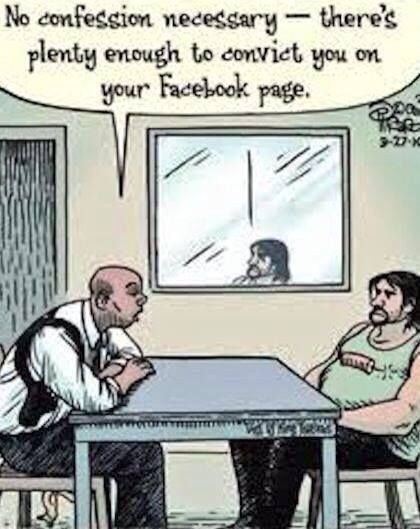
I myself have often thought long and hard about sharing, commenting on and liking the posts I see on Facebook and the memes I receive via WhatsApp and Twitter, after all most of them are extremely funny and admittedly appeal to my basest instincts, without the benefit of any investigation or facts.  Lately, I have gotten better at opting to delete rather than share some of the more questionable posts for fear of an eventual lawsuit or defamation claim.  I humbly suggest that you, my dear reader, do the same.

Think before you click.

Best, 

Simone 

References:

Click to access CvA_13_P154DD26mar2018.pdf

http://www.bailii.org/ew/cases/EWHC/QB/2017/433.html

Click to access monroe-v-hopkins-2017-ewhc-433-qb-20170329-rev-1.pdf

https://www.irishtimes.com/news/crime-and-law/court-cases-show-online-abuse-has-serious-consequences-1.2740985

Click to access Reid-.pdf

https://www.whatsapp.com/legal/#terms-of-service

Click to access cv_16_02996DD01jun2018.pdf

https://www.trinidadexpress.com/news/local/defamation-award-for-facebook-lies/article_0d027f4c-74c1-11e8-ab65-530dc93af7f7.html