Trade marks “®”

A trade mark is a sign capable of distinguishing the goods or services of one trader from those of other traders.  They offer legal protection for any symbol, design, logo, words or combination thereof that represents services or goods.

Trade mark protection offers a number of benefits to the holder of the trade mark. Holders of trade marks can: protect their product or service and initiate legal action against infringers under the Trade Marks Act; license or sell the trade mark thereby monetising it; easily distinguish their goods or services in the marketplace from other competitors; add prestige and brand recognition to the product or service by the use of the “®” after the trade mark.

While there are multiple types of trade marks. There are five main categories of trademarks for products: generic marks, descriptive marks, suggestive marks, fanciful marks and arbitrary marks. For services, there are services marks.

There are also more specific types of Trade Marks such as Trade Dress, Sound Mark, Logotype, Motion Mark, Multimedia Mark, Pattern Mark, House Mark, Hologram Mark, Trade Name, Collection Mark, Position Mark and Family of Marks.

For the purposes of this blog entry I will provide a simple break down of the main categories mentioned.

TYPE OF TRADE MARKMeaning/Description
Generic MarksThese describe everyday words used to describe sellers or their products. To qualify, a generic mark for a trademark, needs to be more specific and to describe qualities, characteristics, or ingredients of the business or the good sold that would distinguish it from other products on the market.
Descriptive MarksThis only serves to describe the product. Descriptive marks have to achieve secondary meaning to qualify for protection. This means that the brand is recognised as coming from a particular source, it moves from ‘what’ it represents, to ‘who’ it represents. eg. McDonald’s.
Suggestive MarksTo qualify, a suggestive mark should cause a customer to use their imagination to figure out what services or goods the company offers. Here the product’s qualities are implied or hinted at without necessarily relating to it in a literal sense or providing a clear description. eg. NETFLIX. These marks are not descriptive but distinctive.
Fanciful MarksThis is a mark, name or logo that is different from anything else that exists and would usually include words that do not hold any meaning in ordinary or common language .eg. Nike.
Arbitrary MarksThis refers to the use of a regular word but in an unconventional way. In this case the word would be unrelated to the product it applies to or signifies .eg. Apple.

A Service Mark is the same as a trade mark, it is used to differentiate an organisation’s class of services from other similar providers, it signifies that a company provides a unique service .eg. American Airlines.

Protection given

Trade Marks registered in Trinidad and Tobago are given the exclusive right to be used for the goods and services they cover in Trinidad and Tobago.

Trade Marks are valid for 10 years from the filing date and are eligible for renewal for successive ten year periods upon filing the prescribed renewal application form and the payment of the appropriate fees. 

For protection outside of Trinidad and Tobago, applicants are required to utilise the Madrid system. To utilise the Madrid system applicants have to complete additional forms and pay additional fees.

Registration

In order to apply for a Trade Mark in Trinidad and Tobago, an application must be submitted the The Trinidad and Tobago Intellectual Property Office (TT IPO) which is the only office assigned with the responsibility for the registration of trade marks in Trinidad and Tobago. Trade Marks registered in Trinidad and Tobago are only valid in Trinidad and Tobago. Applicants must possess an address for service within Trinidad and Tobago, applicants outside of Trinidad and Tobago must have a local agent.

Application

Applicants are required to,

“complete the Application Form (TM-No. 2) in duplicate on size A4 paper and submit the form at the Receiving Office of the Intellectual Property Office together with the application fee. Seven additional copies of the trade mark are also required where the mark is stylized or includes a logo. Where the application is being filed by an agent on behalf of the applicant a Form TM No. 1 must also be completed.” (TT IPO website)

The application form is available online and each application costs TT$1400 for each class of goods or services selected and TT$150 for each additional class in the same application. Applications may be filed electronically or via facsimile.

One should always perform a search for any similar or identical marks that may be in use by others before applying to register a trade mark. 

The procedure for searching for a trade mark by accessing the Intellectual Property Office’s (IPO) website, www.ipo.gov.tt .

In Trinidad and Tobago persons may search the Trade Mark Index Books at no cost. Requests may be made for the Trade Marks Register (for registered marks) or the pending Register (for pending applications) at a cost of TT$50.00 per trade mark.

To apply for a Trade Mark one should have (at the very least) the name and address and nationality of the applicant (the same goes for companies), a copy of the trade mark and the list of services or goods in relation to which the mark will be registered (.ie. the Trade mark’s classification). This classification should be in accordance with the 11th Edition of the Nice Agreement Concerning the International Classification of Goods and Services for the Purposes of the Registration of Marks. 

The process of obtaining a trade mark is not a simple one, so be prepared to invest some time, money and energy in the process.

Is mediation right for you?

Have you ever considered mediation? Do you know what it is? Do you know when it’s appropriate to use mediation as a means of conflict resolution? If you are like most people then your answer may be a cautious, ‘no’. That’s perfectly fine because the majority of people I’ve discussed mediation with often aren’t sure what it is either.

As a certified mediator, I’m always telling persons about the virtues of mediation and how it can be used in every day life. It is a topic that really interests me and I truly believe that mediation is an effective and appropriate way to solve/resolve conflicts in the right circumstances.

Let me begin by explaining what mediation is…

Mediation

Mediation is basically a voluntary, confidential process between disputing parties, facilitated by a neutral, trusted third-party, which aims to resolve the dispute and (hopefully) arrive at a mutually acceptable agreement.

mediation pic

Advantages of mediation

  • It’s cheaper than litigation
  • It’s flexible and can be tailored to the needs of the parties
  • It may settle a dispute more quickly than litigation
  • It’s not as formal as litigation, though parties may choose to have their Attorney’s present
  • It may prevent the further fracturing of the relationships between the parties
  • It is strictly confidential
  • It does not prevent the parties from litigating the matter if it remains unresolved after mediation
  • There are no penalties for failing to reach a settlement
  • Parties could jointly determine/select the mediator
  • For Attorneys, mediation lends itself to improved case management, issue resolution and shortened timelines

These are just a few advantages of mediation, this list isn’t exhaustive.  While mediation works in a number of circumstances, it doesn’t work in every circumstance.

When should you mediate?

Certain circumstances lend themselves to mediation more than others.  In order to determine whether an issue my be mediated try asking the following questions:

  • Do the parties want to maintain their relationship?
  • How many people are involved or indirectly affected?
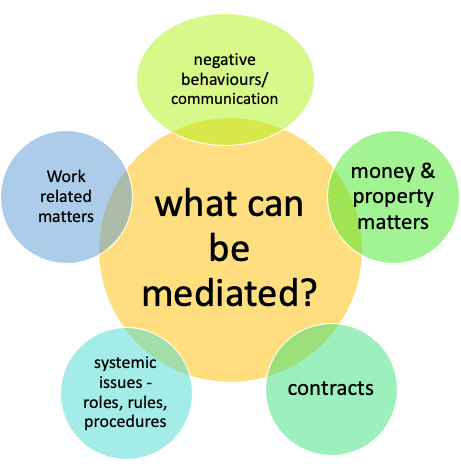
  • Is the disputed issue a ‘tangible’ one?  About money, employment disputes, behaviour, property? These usually tend to be easier to mediate.
  • Is the issue one which the parties want to negotiate?
  • Will the parties voluntarily commit to mediate? Are they  willing to take personal responsibility for the outcome?
  • Are the parties interested in a flexible, less formal process?
  • Is the issue one which would benefit from a complex, creative solution?
  • Do the parties have the authority to agree to a negotiated agreement?
  • Do the parties want to express strong emotions, especially to the opposing side directly?
  • Do the parties need help communicating effectively?
  • Are the parties comfortable with a confidential, private settlement?

When mediation may not be the best option?

Some circumstances are not suited to mediation.  For instance, in divorce matters where there has been a history of domestic abuse or violence, or in instances where parties have a history of distrust and acting in bad faith.

Mediation may not be suitable in:

  • circumstances which one party may intend to use mediation to escalate the dispute,
  • circumstances where a serious incident has just occurred and persons are too emotional or upset to converse,
  • cases where key parties are unwilling to participate,
  • cases that need to establish binding legal precedents, or deter future claims,
  • cases where a party requires public vindication, retribution or exoneration, and,
  • cases where the courts are needed to amend a power imbalance.


To mediate or not to mediate, that is the question?

To arrive at an appropriate answer to this question, the parties have to be brutally honest with themselves.  Every situation is different and each party, their interests and objectives are different, therefore each solution would be different as well.

That being as it is, I firmly believe that mediation is a worthwhile alternative to litigation.  One that is quickly gaining popularity in this jurisdiction.  I’ve provided some source material below.  Please also visit the following local websites for further information:


The Community Mediation Services Division

The Mediation Act 


Best,

Simone

Sources:

When to mediate and when not to mediate

https://ama.asn.au/what-is-mediation/

https://www.mediate.com/articles/what.cfm

https://corporate.findlaw.com/litigation-disputes/what-is-mediation-and-how-does-it-work.html

http://www.dispute-resolution-hamburg.com/mediation/what-is-mediation/

http://kooc.wpengine.com/the-mediation-process/

What is Copyright?

Copyright is a type of intellectual property right which is a collection of rights that protect original works of authorship like a literary works, artistic works, carnival costumes, plays, songs, movies, sound recordings, broadcasts or software/computer programmes. These rights arise automatically and benefit the author.

These rights include moral rights and the right to reproduce or copy the work, to prepare derivative works, to distribute copies, and to perform and display the work publicly.

This right generally lasts for 70 years after the death of the author of the work.

The holder of a copyright can prevent their work from being broadcast, reproduced, translated or adapted.

These rights can be protected through civil and criminal prosecution as well as administrative remedies. Injunctions and specific court orders are also used to enforce these rights.

In Trinidad and Tobago copyright and related rights are obtained automatically so it is not necessary to register or use other formalities. However the local Intellectual Property office does advise authors to use the © along with the creator’s name and date of creation.

Relevant Local laws:

The Copyright Act

The Protection Against Unfair Competition Act

Relevant international conventions and treaties:

Berne Convention (1886-1971)

Rome Convention (1961)

TRIPS

WIPO Copyright Treaty (1996)

WIPO Performances and Phonogram Treaty (1996)

Useful links:

IPO Trinidad and Tobago Copyright Brochure

Workplace Bullying

Recently, I decided to do an entry on the issue of workplace bullying, this issue is one that is particularly important to me having both experienced and witnessed workplace bullying in a number of professional environments.

I’ll start by first defining the term.

What is workplace bullying?

Workplace bullying is defined in Lipinski, Abright and Fenclau (2014) as “a form of interpersonal aggression or antisocial behaviour in the workplace that exceeds what may be considered simple incivility, and is associated with negative outcomes for both perpetrators and victims (Anderson and Pearson, 1999; Neuman and Baron, 2005; Salin, 2003)” . Akella (2016) states that it, “constitutes repeated and persistent negative actions aimed at one or more individuals, which results in the creation of a hostile working environment.” We can agree that this is not a new phenomenon, Hutchinson, Vickers, Jackson, & Wilkes (2004) define it as “an invisible, “intensively, individualized and harmful experience”.

Types of workplace bullying

There are a number of ‘typologies’ and manifestations of behaviour when it comes to workplace bullying, for example, excessive monitoring, unfair and excessive criticism, undermining someone’s decisions, attacking an individual’s professional integrity/reputation, it could also include ignoring an individual, their phone calls and emails and even their contributions in meetings, embarrassing or demeaning them in the presence of work colleagues. Workplace bullying also includes victimisation, physical harassment, power harassment, cyberbullying, verbal harassment, as well as discriminatory harassment, including racial harassment, gender, religious harassment, disability, age and sexual orientation-harassment. Authors, Lipinski, Albright and Fenclau (2014) summerised specific forms of workplace bullying, which included verbal abuse, threatening, intimidating, hostile, offensive humiliating behaviours, sabotage, abuse of authority, the list could go on.

The prevalence of this phenomenon in Trinidad and Tobago is evidenced by the number of articles in the print and online media, online sources and the number of seminars being held to discuss, inter alia, the topic. Within the last year alone, a number of associations and organizations have held presentations on bullying in the workplace and/or workplace violence, amongst them have been the “Northern Branch of the Trinidad and Tobago Nurses Association”, and the University of the West Indies’ Human Resources Division.

Relevant local laws

When I first thought of this blog I decided to look at the Industrial Court of Trinidad and Tobago’s website, I did a search for the terms “bullying” and “workplace bullying”, I was unsuccessful in locating any judgements. I then opted to search for the term “abuse” and 37 search results came up, I was then able to locate some judgements in cases which referenced abuse and abusive behaviour aimed at employees, the details of which could, on the face of it, classify the referenced behaviours as instances of workplace bullying. I subsequently did a search for “harassment” and seven results came up, the majority of which involved sexual harassment (a bit more on this later).

A review of these judgments have also led me to note that some of Trinidad and Tobago’s Laws while not expressly prohibiting “workplace bullying” do prohibit “bullying” type behaviour, inclusive of harassment and abuse. Indeed bullying may become illegal when it violates laws which prohibit discrimination or harassment in the workplace. Such pieces of legislation would include the Industrial Relations Act (IRA), Chapter 88:01; the Occupational Safety and Health (OSH) Act, Chapter 88:08; the Offences Against the Person (Amendment) (Harassment) Act, 2005, and the Equal Opportunities Act (EOA) 2000. The OSH Act indicates that an employer has a duty under section 6 (1) to “ensure, so far as is reasonably practicable, the safety, health and welfare at work….” The EOA prohibits discrimination against an individual based on their status or characteristic, it also prohibits victimisation and discrimination in employment. In particular, the Offences Against the Person (Amendment) (Harassment) Act 2005 defines harassment and makes it unlawful to carry out the prohibited course of conduct. Organisations such as the International Labour Organisation (ILO) also provide guidelines for addressing workplace violence.

Experiences of workplace bullying

I daresay that everyone who has ever worked for and with other people in these blessed lands has either witnessed, experienced or carried out an act of workplace bullying. In workplaces across these islands we have all heard (or started/contributed to) a malicious rumour about a colleague who got a promotion under dubious circumstances, there is usually a gender dimension to the bullying that takes place in such instances as well.

There is a recognised link between discrimination and harassment but not necessarily bullying. I submit that there is such a link, for example, I’m quite sure that we’ve all witnessed bullying in the form of an abuse of power where someone in authority uses his/her position to excessively monitor and intimidate a junior member of staff (whom they’ve ‘selected’ based on some ‘status’ or characteristic that the more powerful individual deems unacceptable), monitoring their phone usage as well as how long the employee takes when visiting the bathroom, and proceeds to use this information to victimise or censure the individual in front of other members of staff. I’ve even witnessed a person, who subsequently rose to an extremely senior leadership role in the civil service, berate an employee, in full view and earshot of their colleagues, for wearing a work suit that did not meet that senior person’s standards for workplace dress, mind you, there was no dress code in place at the time and to my mind the employee was not dressed inappropriately.

I’ve witnessed persons using their positions to intimidate persons into doing work that was not originally assigned to them and then threatening them with bad performance reports if they did not carry out these demands. Over the years I’ve even witnessed members of the political directorate participate in workplace bullying by using their unique brand of intimidation to defame, slander and libel persons who work for and around them if the individual(s) did not comply with their, usually ‘irregular’, instructions. I’ve seen and heard them shout at, scream at and threaten employees and I’ve seen them cyber-stalk (if that’s a term) employees to get their way.

Effects of workplace bullying

Workplace bullying could have a number of negative impacts on the ‘victim’ and the witnesses, aside from lowered employee morale, there have been documented cases where persons have suffered genuine medical issues as a result of workplace bullying. The Canadian Centre for Occupational Health and Safety (CCOHS) lists a number of impacts on the individual and the workplace, an individual may experience feelings of anger, frustration, loss of confidence, panic attacks, stress, physical symptoms such as the inability to sleep, the loss of appetite as well as stomach pains and headaches. The CCOHS indicates that the workplace may also be negatively affected by increased absenteeism, costs for employee assistance programs, staff-turnover and decreased productivity and customer confidence and customer service.

If you feel that you’re being bullied…

Of late I have observed that persons are becoming more and more aware of their rights and how they can protect them. The referenced Offences Against Person (Harassment) (Amendment) Act as well as the EOA set out an employee’s relevant rights and prohibits the referenced negative behaviour. Landau (2017) suggests that if an individual feels that he/she is being bullied they should try to handle the situation informally by talking to an HR rep or even the guilty party, if this doesn’t work, the employee could then lodge a formal complaint/grievance which the employer would then have to address using their internal formal procedures. It is advisable that the employee keep a diary of events, a record of all correspondence, the names of witnesses, the location of the incident(s) and a log of phone calls and text messages. I’d also include evidence of social media posts, tweets and direct messages. I’m reluctant to suggest voice recordings given the other legal implications and what transpired in the United States in the recent past, a la Omarosa (remember her?).

Specific Legislation

It is indeed unfortunate that Trinidad and Tobago has yet to create ‘specific’ legislation and policies on workplace bullying when a few of our Commonwealth partners have done so, for instance Australia, the United Kingdom and Canada. Australia’s Fair Work Amendment Act 2013 defines workplace bullying as, “repeated unreasonable behaviour by an individual towards a worker which creates a risk to health and safety.” There is even a Fair Work Ombudsman who assists workplaces with resolving their issues related to bullying and other matters under the Act’s remit.

In the English-speaking Caribbean there has been, of late, a great deal of focus on Sexual Harassment, which I have not touched on to any great degree in this particular blog entry, as I believe that it is a separate issue that deserves special attention given it’s grave importance. This notwithstanding, it is an occurrence that can stem from workplace bullying or lead to it as well. If you’d like to get some more information on Trinidad and Tobago’s sexual harassment policies, have a look at the Equal Opportunities Commission’s Guidelines on Sexual Harassment in the Workplace. There is also a National Workplace Policy on Sexual Harassment from which relevant legislation would arise. Judgements from the Industrial Court of Trinidad and Tobago would also provide guidance on how this issue should be handled in the workplace well. The President of the Industrial Court has also delivered a presentation on this issue which can be found on the Court website.

I hope you’ve enjoyed this piece and that it’s given you food for thought.

Best,

Simone

References  

Akella Devi (2016). Workplace Bullying: Not a Manager’s Right? In the Journal of Workplace Rights, January-March 2016: 1-10.

Australian Fair Work Ombudsman, https://www.fairwork.gov.au/

Canadian Centre for Occupational Health and Safety, https://www.ccohs.ca/oshanswers/psychosocial/bullying.html 

Equal Opportunities Commission, Guidelines on sexual harassment in the workplace, https://equalopportunity.gov.tt/publications/publications-new-collection/guidelines-sexual-harassment-in-the-workplace.html

Hutchinson, M, Vickers, MH, Jackson, D & Wilkes, L 2004, ‘Organisational restructuring: an opportunity for bullying – preliminary findings from a studying of bullying in the Australian nursing workforce’, paper presented to Nursing leadership, policy and politics : Royal College of Nursing, Australia, National Conference and the 38th Patricia Chomley Oration, Alice, Springs, NT, 14-16 July.

Landau, Phillip. https://www.theguardian.com/careers/2017/mar/29/bullying-at-work-your-legal-rights

Lipinski, J. (Ed.), Crothers, L. (Ed.). (2014). Bullying in the Workplace. New York: Routledge.

Lipinski, J, Albright, C.M, & Fenclau E.J (2014) History of bullying in the American Workplace. In J. Lipinski and L.M. Carothers (eds.) Bullying in the Workplace. New York: Routledge.

Ministry of Labour and Small Enterprise, https://labour.gov.tt/mediaroom/latest-news-events/9-uncategorised/359-national-workplace-policy-on-sexual-harassment


Intellectual Property Rights

Intellectual Property Rights (IPRs)

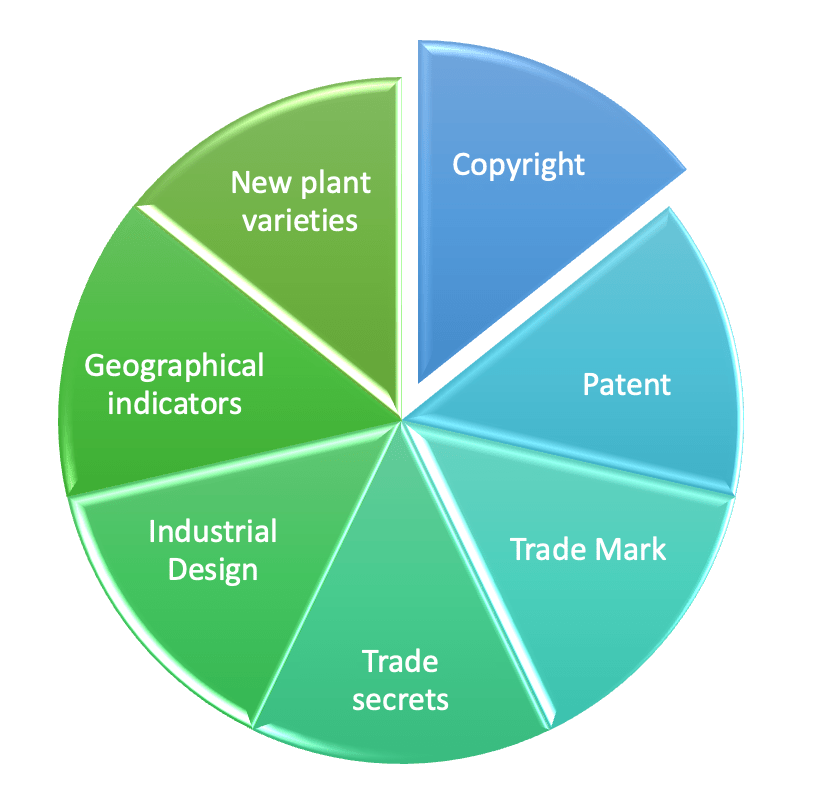
Intellectual Property Rights (IPRs) are made up of a family of rights, the most common being copyright, patents and trade marks, though there are many others such as trade secrets, industrial designs, geographical indicators and so on. This series of blog entries will just skim the surface of this very complicated topic and give the reader a basic understanding of the types of IPRs.

Copyright

Copyright pertains to literary and artistic works that are original.  Copyright therefore applies to novels, poems, plays, reference works, articles, computer programmes, databases, films, musical compositions, paintings, drawings, photographs and maps.

Patents

A patent is an exclusive right granted for an invention.  For a patent to be granted there must be an inventive step.  The invention must be a process or a product which invents a novel way of doing something or a novel technical way of solving a problem.  The invention must be capable of industrial application.

This right grants the holder protection from having their invention used, manufactured or traded by unauthorised persons.

Trade marks

A trade mark is a sign capable of distinguishing the goods or services of one trader from those of other traders.  Trade marked good and services refer to the, in local parlance, “brands” used by one entity or person to  distinguish a good or service from others.

The US Patent and Trademark office indicates that a trademark:

  • Identifies the source of your goods or services.
  • Provides legal protection for your brand.
  • Helps you guard against counterfeiting and fraud.

A quick word on Trade Secrets

Trade secrets refer to confidential information that may be sold or licensed.  These secrets usually refer to commercial information such as recipes, business and manufacturing processes, client lists, suppliers lists, sales and advertising strategies.  They may also refer to technical information such as computer programmes and test data.

To qualify as a trade secret, this information must be know to a limited number of persons and be commercially valuable.  These persons must take all the necessary steps to keep this information secret. 

Sources and useful links:

Trinidad and Tobago IPO 

https://www.wipo.int/about-ip/en/

https://www.uspto.gov/trademarks/basics/what-trademark

https://www.wipo.int/tradesecrets/en/

Copyright Act

Patents Act

Trade Marks Act