The Business of Lawyering

I’m dedicating my posts for the second quarter of 2023 to legal entrepreneurship and my own entrepreneurial journey.

I decided to share what I’ve learnt after 4 years in private practice,
what works and what doesn’t for new lawyers or lawyers new to private practice.

To start, here are some key points to note:

First off, get your practice areas together, identify the knowledge required, set clear and realistic objectives/targets.

Second, who are your target clients, what are your prices? Admittedly, I’ve had a lot of trouble with the latter question 🙂 a good colleague of mine actually told me at one point that I was charging, and I quote, “piper prices”. I’ve been traumatised ever since. Do an industry scan, take into consideration the relevant legislation and by all means use your discretion. I’ve always been pretty clear on who my ideal clients are, so start there, envision the type of person you want to serve and start paying attention to what that person would need by way of legal assistance and service.

Third, location, location, location, where are you positioning yourself? Is your office, both the physical and virtual locations in places where your clients and potential clients can find you?

Fourth, resources required…. What do yo need to start? I mean, what is the bare minimum required? A computer, a printer? A desk, chair? Internet connection? Other utilities? List them out, cost them and then budget and form a plan on how you’re going to get them.

Fifth, support and colleagues…. Get yourself a circle of like-minded, focused, open, supportive colleagues and relatives or friends. They are more important than you think. This circle doesn’t have to be large, but it does have to be stable and the persons in it need to be open, trustworthy, transparent, honest and supportive.

Sixth, the requirement for ongoing training and networking….Always be willing to admit that you don’t know. I don’t know a lot of things, being open about your areas of ignorance will earn you a lot more respect in the long run than pretending, and lying, about knowing about something. Always put aside some of your hard-earned cash to invest in yourself and ongoing education and training even in non-legal fields. Networking is something that I’ve always had to do as a professional, from my very first job out of university to the present day. I’ll be honest and say I hate it, but that doesn’t mean I don’t do it well. It’s a skill like any other that you have to develop and hone and that only happens with practice. Networking may mean a lot of things but it does not mean, pretence and inauthenticity. The next time you go to any function, be it at church or for work or even a social event, set yourself the task of finding one person you don’t know and learning about them. Be genuinely interested in learning about this person, listen to them even if it’s only for a few minutes, look for something to connect with them about, find something in common. People know when other people are being authentic and they respond in like manner. That’s true connection and that’s the best kind of networking there is.

And…..

Seventh, inner fortitude, goals, self knowledge. Spend some time with yourself often. Set continually updated goals and really identify a clear vision for yourself and move toward it steadily, even if it takes you longer than other people. Don’t compare yourself to others in the field, their journey is not your journey, their history, story and experiences are not your own. You are unique, go inward, find what makes you stand out and then focus on nurturing that area of yourself and your craft or profession.

So that’s it for this first instalment. My next posts on this topic will be about using IT tools in your lawyering business and then I’ll post about a ‘newish’ business model that I recently came across and how I think it could be used and integrated into a lawyering business in the Caribbean.


A PSA : Some advice on the importance of having ‘T&T Identification’

It’s extremely important/imperative that you have local identification issued by the Government of the Republic of Trinidad and Tobago, if you’re a citizen and trying or planning to conduct business in Trinidad and Tobago especially opening a bank account or purchasing or selling property or other assets in Trinidad and Tobago.

You should aim to have at least two forms of ID, a national ID card issued by the Elections and Boundaries Commission (EBC) and possibly a passport or driver’s permit. It is also important to have a local address and proof thereof. This proof comes in the form of a utility bill eg. TTEC, WASA or bank statement no more than 3 months old. The utility bill should ideally be in your name, but if it is not, the person whose name appears on the bill should give you an authorisation letter stating that the address is your address in Trinidad and Tobago and that as the owner they’ve given you permission to use the address, a copy of their ID should accompany said letter.

Please also apply for and obtain your birth certificate and other certificates such as your marriage certificate (if applicable). These certificates are also extremely important, they are required to access services at the Registrar General’s Department such as the CROS and to apply for and access the TTBizlink and the Etax services. If you need to apply for these documents you may do so at the Registrar General’s Department.

There may be other additional requirements for different institutions such as the banks, credit unions and the Unit Trust Corporation (UTC), please ascertain same and ensure that you have all the documentation you need before attempting to conduct business in this jurisdiction. Trust me it will save you time, money and additional stress if you heed my advice.

Important links:

https://licensingappointment.mowt.gov.tt

https://ebctt.com

Immigration Division

Ministry of the Attorney General – Registrar General’s Department

https://info.ttbizlink.gov.tt/#/

https://www.etax.ird.gov.tt/_/

Articles of Incorporation and Company Bye-Laws, are they the same?

Short answer: No, they are not.

Clients interested in incorporating a company often ask me to explain the difference between the Articles of Incorporation (AoI) and the Company’s Bye-laws (Bye-laws).

I decided to do this simple (hopefully short) post to help persons understand the difference between these two very important documents.

Articles of Incorporation

Basically, the AoI form a document that is filed with the government agency with oversight for the registration and regulation of businesses and companies in a particular company. In Trinidad and Tobago’s case, the Registrar General is the government department with such responsibility and the Companies Registry housed within the Registrar General’s Department is responsible for the registration of companies.

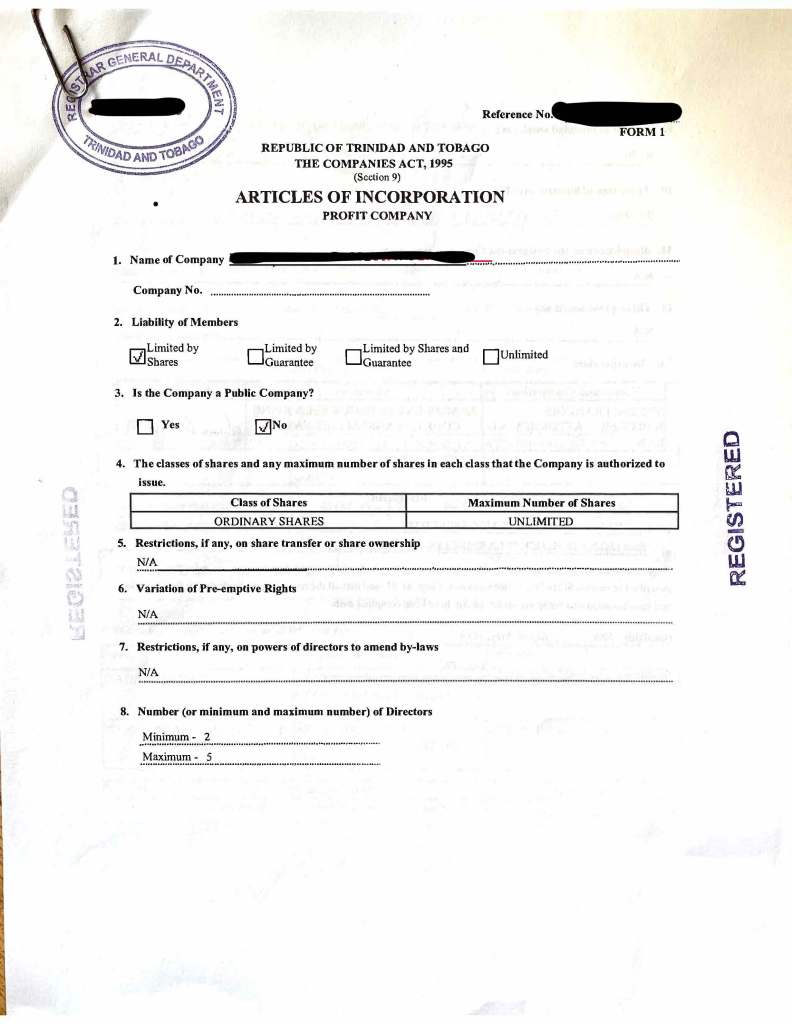
The AoI allows the business to be recognised as a functioning legal corporation. Included in the AoI are basic pieces of information such as the company name, place of business, date of formation, the number of directors as well as the number and types of shares to be distributed; these have to be filed with the Companies Registry for incorporation to take place.

Companies Act Ch. 81:01 of the Laws of Trinidad and Tobago:

12. Upon receipt of articles of incorporation which comply with the provisions of this Act, the Registrar shall issue a certificate of incorporation in accordance with section 481 and the certificate is conclusive proof of the incorporation of the company named in the certificate.

13. A company comes into existence on the date shown on its certificate of incorporation.

Example of the first page of the Articles of Incorporation after registration

Bye-laws

Bye-laws on the other hand are the detailed rules, guidelines or operating agreements by which the company would be run. The Bye-laws do not have to be filed with the government agency while the AoI do.

I like to think of the AoI as the framework within which the Bye-laws operate. Or to put it another way, the AoI is the body while the Bye-laws are the life’s blood of the company. If something goes wrong with the Bye-laws the company will be sick and unable to function properly.

The Bye-laws are one of the first items to be established by the Board of Directors of a company. They are usually created after the AoI are filed and the company registration approved and finalised. The Bye-laws have to be consistent with your AoI.

I’ll do another blog post to discuss what a company’s Bye-laws look like.

Have a look at these other useful websites:

http://legalaffairs.gov.tt/about.php

https://www.contractscounsel.com/t/us/corporate-bylaws

https://corporatefinanceinstitute.com/resources/knowledge/finance/company-bylaws/

Patents 101

I’m sure you’ve all heard about Patents but you’re not completely 100% sure what this term means. Admittedly, whenever I hear this word pictures begin floating around in my mind of old men in dusty labs writing formulas and coming up with weird inventions. That’s not quite it.

According to the WIPO, a patent,

“is an exclusive right granted for an invention, which is a product or a process that provides, in general, a new way of doing something, or offers a new technical solution to a problem. To get a patent, technical information about the invention must be disclosed to the public in a patent application.”

Patents give incentives to inventors by offering them opportunities for recognition and monetary rewards for their work. The granting of a patent encourages other inventors to develop new technologies and innovations which generally improve and bring value to our everyday lives.

A great many things may be patented, eg. nanotechnology, medicines, computer software (which may also qualify for copyright protection), machinery and processes. However there are a few categories of things that may not qualify for a patent, inter alia, ideas, literary works, hypotheses, a presentation of information, diagnostic, therapeutic and surgical methods used on the human and animal body and any invention which may be contrary to public order or morality.

That being said it should be noted that the process for applying for a patent is a somewhat complex and expensive one, which I have attempt to simplify below.

Applying for a Patent

Firstly, your invention must met certain criteria, it must :

  • Be Novel: Your patentable invention must be new, it must be different from what is available in the public domain, nothing like it must be in existence.
  • Be Useful or have industrial utility/applicability: Your patentable invention must work, serve a useful purpose and accomplish something.
  • Include an inventive step: Your patentable invention must be unconventional and non-obvious to someone with average skill in the same art.

In Trinidad and Tobago applications for Patents are governed by the Patent Act and Patent Rules of 1996 and must be filed at the Trinidad and Tobago Intellectual Property Office (TT IPO). Applicants must complete and file,

1) The Patent Request Form No. 1.
2) A disclosure of the invention must accompany the application. This is the specifications of the invention, which include: Descriptions, Claims, Abstract & Drawings (if necessary).

The application must be submitted in triplicate on A4 size paper as outlined in Rule 16 of the Patents Rules (above), together with the application fee of TT$2000. The application may be submitted by the applicant or his attorney.

After the application is filed, it goes through the following steps: the formality examination, the substantive examination, the publication and issuance of the certificate.

Protection granted

Patents are granted for 20 years, they are territorial rights. These exclusive rights are only applicable in the country or region in which a patent has been filed and granted. The patent’s owner has the exclusive right to prevent or stop others from commercially exploiting the patented invention. ie. the invention cannot be commercially made, used, distributed, imported or sold by others without the patent owner’s consent.

Once the patent is granted maintenance fees or annuities have to be paid to retain the patent, these fees increase during the course of the 20 year term of the patent and must be paid annually from the filing date, beginning at the start of the second year. Note that the application may be withdrawn or revoked if the fees are not paid.

Trinidad and Tobago is a Member state of the Paris Union and the Patent Corporation Treaty therefore applicants in Trinidad and Tobago have the option to also apply for patents in any of the other respective member states within certain time frames.

Some advice

Do not tell others about your invention, the TT IPO advises persons, not to “publicly disclose the invention more than a year before” they file an application. This could be counted as prior publication of their invention. “Any type of disclosure (whether by word of mouth, demonstration, advertisement or article in a journal), by the applicant or anyone acting for them, could prevent the applicant from getting a patent. It is essential that the applicant only make any disclosure under conditions of strict confidence.”

Following this I would suggest that patent applicants have persons sign non-disclosure agreements if they absolutely have to disclose information about their invention to them.

Applicants may also wish to consider doing a patent search before applying for a patent. The WIPO provides the facility to conduct these searches via the patent information services for developing countries. The TT IPO also provides a great deal of patent related resources on its website.

Useful links:

Trinidad and Tobago Intellectual Property Office

Service Contracts & Small Businesses

Owners of small businesses approach me from time to time to find out how to draft contracts that would regulate their interactions with their customers. It’s been my experience that small businesses that provide services do not need a lot of fluff when constructing contracts to meet their needs. Simple service contracts tend to be the easiest and fastest way to go when it comes to setting out the terms of engagement with customers and clients.

A service contract is a contract between a business and its clientele or customers. This contract outlines the terms and conditions of the services provided, inclusive of the particular work to be conducted, the amount and method of payment. It should, ideally, be in writing, with clear, simple, unambiguous terms/words utilised.

There are many advantages to having properly drafted service contracts such as, clarity with regard to the nature of the service being provided, time lines, roles and responsibilities, standards of performance, payment details as well as service location(s). These contracts also contribute to more certainty in the transaction as well as added trust in the customer/service provider relationship.

A basic written service contract, regardless of the field of work, should include the following:

  • Official names, addresses and contact information of the parties involved (get copies of the parties’ government issued ID if possible)
  • Clear, detailed outline of the service to be provided
  • Service location(s) (if any)
  • Timeline of service
  • Payment terms, amount and method
  • Any warranties* or guarantees *
  • Indemnification terms*
  • Non competition clauses
  • Non-solicitation (non-poaching) clauses
  • Non-disclosure, confidentiality clauses
  • Dispute resolution mechanisms such as mediation, arbitration etc.
  • Remedies for any breaches
  • Termination clauses

*These should be drafted with care as there are laws that address the terms in these clauses. eg. The Consumer Protection and Safety Act ; The Unfair Contract Terms Act , The Sale of Goods Act (which refers to goods/products).

Anytime a business provides a service to a client, a service contract should be prepared, negotiated and ultimately signed by each party. Each party should retain a copy of the signed contract for their records. This formalisation of the business relationship helps the small business/service provider to protect their own interests and ensure that they are paid for the work performed, failing which the service provider is given a stronger basis upon which to pursue their compensation.

For customers, service contracts are also quite beneficial, in that, they provide a higher degree of certainty and protection by clearly outlining the scope of work, payment terms, timelines and personnel involved and a stronger basis upon which they could pursue their interests in the event that there is a breach of contract.

This being said, termination and dispute resolution clauses are especially important because they save the parties time, expense and stress later on if they are unable to fulfil their contractual obligations. These clauses should outline the conditions under which the contractual terms may re-negotiated, disputes may be resolved or the contract terminated and the remedies that would result.

A word of advice:

Always do a “reckie” (reconnaissance, background check) on any party with whom you may be entering into a contract. This goes for both customers/clients and businesses/service providers. This sort of due diligence goes a long way in preventing the stress, heartache and expense that arises when we do business with the wrong persons.

While the list of terms and information for inclusion in a service contract provided above is an exhaustive one it is not intended to be a substitute for professional legal advice when it is warranted. Remember to always seek professional, independent legal advice before signing any contract.

Good luck!