
Have you ever considered mediation? Do you know what it is? Do you know when it’s appropriate to use mediation as a means of conflict resolution? If you are like most people then your answer may be a cautious, ‘no’. That’s perfectly fine because the majority of people I’ve discussed mediation with often aren’t sure what it is either.
As a certified mediator, I’m always telling persons about the virtues of mediation and how it can be used in every day life. It is a topic that really interests me and I truly believe that mediation is an effective and appropriate way to solve/resolve conflicts in the right circumstances.
Let me begin by explaining what mediation is…
Mediation
Mediation is basically a voluntary, confidential process between disputing parties, facilitated by a neutral, trusted third-party, which aims to resolve the dispute and (hopefully) arrive at a mutually acceptable agreement.

Advantages of mediation
- It’s cheaper than litigation
- It’s flexible and can be tailored to the needs of the parties
- It may settle a dispute more quickly than litigation
- It’s not as formal as litigation, though parties may choose to have their Attorney’s present
- It may prevent the further fracturing of the relationships between the parties
- It is strictly confidential
- It does not prevent the parties from litigating the matter if it remains unresolved after mediation
- There are no penalties for failing to reach a settlement
- Parties could jointly determine/select the mediator
- For Attorneys, mediation lends itself to improved case management, issue resolution and shortened timelines
These are just a few advantages of mediation, this list isn’t exhaustive. While mediation works in a number of circumstances, it doesn’t work in every circumstance.
When should you mediate?
Certain circumstances lend themselves to mediation more than others. In order to determine whether an issue my be mediated try asking the following questions:
- Do the parties want to maintain their relationship?
- How many people are involved or indirectly affected?
- Is the disputed issue a ‘tangible’ one? About money, employment disputes, behaviour, property? These usually tend to be easier to mediate.
- Is the issue one which the parties want to negotiate?
- Will the parties voluntarily commit to mediate? Are they willing to take personal responsibility for the outcome?
- Are the parties interested in a flexible, less formal process?
- Is the issue one which would benefit from a complex, creative solution?
- Do the parties have the authority to agree to a negotiated agreement?
- Do the parties want to express strong emotions, especially to the opposing side directly?
- Do the parties need help communicating effectively?
- Are the parties comfortable with a confidential, private settlement?
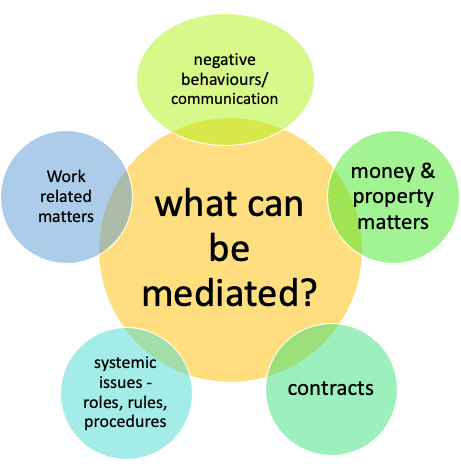
When mediation may not be the best option?
Some circumstances are not suited to mediation. For instance, in divorce matters where there has been a history of domestic abuse or violence, or in instances where parties have a history of distrust and acting in bad faith.
Mediation may not be suitable in:
- circumstances which one party may intend to use mediation to escalate the dispute,
- circumstances where a serious incident has just occurred and persons are too emotional or upset to converse,
- cases where key parties are unwilling to participate,
- cases that need to establish binding legal precedents, or deter future claims,
- cases where a party requires public vindication, retribution or exoneration, and,
- cases where the courts are needed to amend a power imbalance.
To mediate or not to mediate, that is the question?
To arrive at an appropriate answer to this question, the parties have to be brutally honest with themselves. Every situation is different and each party, their interests and objectives are different, therefore each solution would be different as well.
That being as it is, I firmly believe that mediation is a worthwhile alternative to litigation. One that is quickly gaining popularity in this jurisdiction. I’ve provided some source material below. Please also visit the following local websites for further information:
The Community Mediation Services Division
Best,
Simone
Sources:
When to mediate and when not to mediate
https://ama.asn.au/what-is-mediation/
https://www.mediate.com/articles/what.cfm
https://corporate.findlaw.com/litigation-disputes/what-is-mediation-and-how-does-it-work.html
http://www.dispute-resolution-hamburg.com/mediation/what-is-mediation/

 Phoenix Legal and Consulting Services