
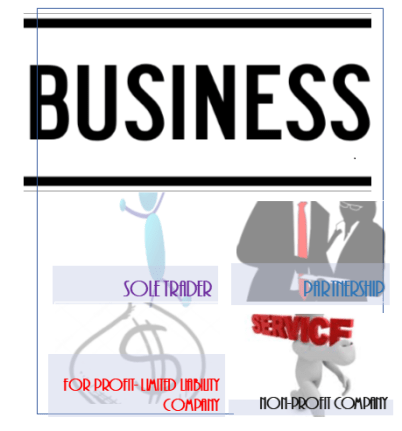
In Trinidad and Tobago one can open various types of businesses, this list includes but is not limited to a sole trader/sole proprietorship, a for profit company, a non-profit company and partnerships.
Two of the most common types of business that we encounter in Trinidad and Tobago are the sole trader and limited liability (for profit) company. Your choice of business depends on your personal goals and resources.
Sole Traders
Many self-employed persons opt to register their business as a sole trader. A sole trader is the simplest and most cost effective form of a business that you can register. You don’t need to be an attorney or accountant to do so, the process has become increasingly simplified at the Companies Registry and you may opt to do it yourself if you have the time, resources and patience to do so. As a sole trader you will be legally responsible for all aspects of the business. You’ll generally make all the decisions about all aspects of running your business.
There are a number of advantages:
- You have complete autonomy with business decisions
- You have fewer reporting responsibilities
- It’s easy to change your business structure as circumstances dictate
One major disadvantage involves that of liability, as a sole trader you are responsible for all liabilities of the business. Your liability is unlimited inclusive of your personal assets and jointly-owned assets such as a home or vehicle.
On average, the registration of a sole trader business in Trinidad and Tobago could take a few days with the new Companies Registry Online System – CROS (which I will discuss later on in the blog) once your name search is done correctly and the name you’ve selected has been approved for subsequent registration. A point to note, the name you select must be thoughtfully selected and must not be inflammatory, convey some illegality or duplicate the name of a previously registered or incorporated business. My advice: conduct a thorough name search!
For Profit – Limited Liability Company
A for profit business on the other hand is one that, in most instances, people opt to incorporate as a limited liability company or LLC. A LLC has a number of advantages, its owners are not personally liable meaning that their personal assets are protected and the company has its own corporate identity. The company can perform actions in its own name such as opening its own bank accounts, purchasing property and other assets such as vehicles. A company can also be sold or passed on.
There are however a number of disadvantages as well, there is reduced control and there may be disputes among owners on how to manage and run the company. The accounts for such a company would be more complex and the services of an accountant would most likely have to be retained and you would have to determine how to take out your earnings from the company.
If you do decide to set up such a business you would have to decide on a suitable company name, the registered address of the company, name at least two (2) directors including a secretary, and determine the details of the company’s shares and decide on the articles of incorporation and file annual returns thereafter. The incorporation process could generally take a few days, or even less, once your name search and reservation are completed in a timely manner, all your documents are in order and there are no queries on the application. This incorporation process can now be done via the CROS.
After a business is registered or incorporated one has to consider the tax requirements. In Trinidad and Tobago the Inland Revenue Division of the Ministry of Finance is the competent authority that handles these matters. I’ve attached the following link from the Ministry of Finance which provides guidance on VAT Registration .
A bit about the CROS
The registration of businesses and company incorporation are now only available online. The MAGLA has launched its new Companies Registry online system or CROS , I’ve had the opportunity to use this online method of company incorporation, in my experience there are some operational hiccups and the process is a bit convoluted.
As a service provider myself, registering for the online facility to provide the online service to my clients was a bit time consuming, to start you have to apply for a Companies Registry Account (CRA) Account and then jump through a few other hoops to ensure that you could conduct business for your clients. Payment is not yet available using credit cards online, so one still has to go in to the Ministry to top up one’s CRA online account. In the end the convenience of being able to do some things such as company searches etc online can be said to outweigh the initial hassle.
The Digital Divide
After discussing these changes with my father, I feel moved to say one thing about this warp speed movement towards the wholesale adoption of ICTs as the only means of conducting some forms of business. Those in authority must be mindful that there are large number of persons in our society that still do not have access to the internet and are not computer literate. Are these persons going to be seen or ignored as collateral damage and simply left behind by the wholesale adoption of these ICT tools and thereby become effectively disenfranchised by these developments? This discussion brings to mind the debate on the digital divide … I’ll write more about these concerns in another blog post.
When all is said and done, if a business is what you want to start, if you have some burning entrepreneurial goal or vision for yourself or your family: go for it!
If, however, you find the process to be too much, too timely or too frustrating for you handle there are many service providers, who will complete the entire process for you.
I’ve included some useful links below for your ease of reference.
Best,
Simone
Useful Links:
Companies Registry online search facility
InvestTT – Setting up a business in T&T
The World Bank – Ease of Doing Business in Trinidad and Tobago

 Phoenix Legal and Consulting Services